Archive for “techniques”

The Accompanist

Much food for thought at the joint AMED / IAF Europebuilding bridges‘ facilitation day last week.

I find myself day dreaming and speculating about a particular kind of helping role: the accompanist.

Vicky Cosstick mentioned this in passing, when setting up her session on the glimpses of the future of facilitation.  Early in her career, Vicky played this role as part of her training.   The role apparently has its origins in spiritual practice, although I’d not come across the term used in this way before.

What does an accompanist do?

The role involves minimal intervention.  You attend the work of the group and listen.  You write up to a maximum of one page of observations.  You pose two or three open questions as part of that.  The group can choose to do something with these, or not.

It reminded me of the practice that Edgar Schein describes in Organisational Culture and Leadership, where he too spends much of his time observing.

What a wonderful way to work with a client / self.

What’s the minimum we can do, to help?

Facilitation training – can it work one-to-one?

I love to train people in facilitation skills.  It’s so much fun!

People get to try new things in a safe environment, games are played, there’s growth and challenge, fabulously supportive atmospheres can build up.

What’s the minimum group size for this kind of learning?

How about one?

A group of one

From time to time I’m approached by people who want to improve their facilitation skills, but who don’t have a ready-made group of colleagues to train with.   I point them towards open courses such as those run by the ICA, and let them know about practice groups like UK Facilitators Practice Group.  And sometimes, I work with them one-to-one.

This one-to-one work can also happen because a client doesn’t have the budget to bring in facilitator for a particular event, and we agree instead to a semi-coaching approach which provides intensive, just-in-time preparation for them to play the facilitator role.  This is most common in the community and voluntary sector.

The approach turns out to be a mix of process consultancy for specific meetings, debriefing recent or significant facilitation experiences, and introducing or exploring tools and techniques.

Preparing to facilitate in a hierarchy

A client had a particular event coming up, where she was going to be facilitating a strategy session for a group of senior people from organisations which formed the membership of her own organisation.  She had concerns around authority: would they accept her as their facilitator for this session?  She was also keen to understand how to agree realistic aims for the session, and to come up with a good design.

We spent a couple of hours together, talking through the aims of the session and what she would do to prepare for it.  We played around with some design ideas. I introduced the facilitator’s mandate, and she came up with ways of ensuring she had a clear mandate from the group which she could then use to justify – to them and to herself – taking control of the group’s discussions and managing the process.  Helped by some coaching around her assumptions about her own authority, she came up with some phrases she was comfortable using if she needed to intervene.  We role-played these. She felt more confident about the framework and that the time and energy we’d put into the preparation was useful.

Facilitation skills as a competence for engaging stakeholders

As part of a wider team, I’ve been working with a UK Government department to help build their internal capacity for engaging stakeholders.  As a ‘mentor’, I worked with policy teams to help them plan their engagement and for one team, this included helping a team member get better at meeting design and facilitation.  He already had a good understanding of the variety of processes which could be used and a strong intuitive grasp of facilitation.  We agreed to build this further through a (very short) apprenticeship approach.  We worked together to refine the aims for a series of workshops.  I facilitated the first and he supported me.  We debriefed afterwards: what had gone well, what had gone less well, and in particular what had he or I done before and during the workshop and what was the impact.  He facilitated the next workshop, with me in the support role. Again we debriefed.  We sat down to plan the next workshop, and I provided handouts on carousel, which seemed like an appropriate technique. I observed the next two workshops, and again we debriefed.

Instead of a training course

I worked with a client who wanted to develop his facilitation skills and was keen to work with me specifically, rather than an unknown and more generic open course provider.  I already knew his context and he knew I’d have a good appreciation of some of his specific challenges: being in the small secretariat of what is essentially an industry leadership group which is trying to lead a sustainability agenda in their sector.  His job is to catalyse and challenge, as well as to be responsive to members.  So when he is planning and facilitating meetings, he will sometimes be in facilitator mode and sometimes he will need to be advocating a particular point of view.

Ideally, I’d have wanted to observe him in action in order to identify priorities and be able to tailor the learning aims. But the budget didn’t allow for this.

We came up with a solution which was based on a series of four two-hour sessions, where I would be partly training (i.e. adding in new ‘content’ about facilitation and helping him to understand it) and partly coaching (i.e. helping him uncover his limiting assumptions and committing to do things differently).  The sessions were timed to be either a bit before or a bit after meetings which he saw as significant facilitation challenges, so that we could tailor the learning to preparing for or debriefing them.  The four face-to-face sessions would be supplemented by handouts chosen from things I’d already produced, and by recommended reading.  We agreed to review each session briefly at the end, for the immediate learning and feedback to me, and partly to model active reflection and to get him into the habit of doing this for his own facilitation work.

In our initial pre-contract meeting, we agreed some specific learning objectives and the practicalities (where, when).  Before each session, we had email exchanges confirming what he wanted to focus on. This meant I could prepare handouts and other resources to bring with me.

And this plan is pretty much what we ended up doing.

He turned out to be very well suited to this way of learning. He was a disciplined reflective practitioner, making notes about what he’d learnt from his experiences and bringing these to sessions.  He was thoughtful in deciding what he wanted to focus on which enabled me to prepare appropriately.  For example, in our final session he wanted to look at his overall learning and to identify the learning edges that he would continue to work on after our training ended.  We did two very different things in that session: he drew a timeline of his journey so far, identifying significant things which have shaped the facilitator he is now.  And we used the IAF‘s Foundational Facilitator Competencies to identify his current strengths and learning needs.

Can it work?

Yes, it’s possible to train someone in facilitation skills one-to-one.   This approach absolutely relies on them have opportunities to try things out, and is very appropriate when someone will be facilitating anyway – trained or not.  The benefits are finely tailored support which can include advice as well as training, coaching instead of ‘talk and chalk’, and debriefing ‘real’ facilitation instead of ‘practice’ session.

There are downsides, of course.  You don’t get the big benefit which can come from in-house training, where a cohort of people can support each other in the new way of doing things and continue to reflect together on how it’s going. And you don’t get the benefit of feedback from multiple perspectives and seeing a diverse way of doing things, which you get in group training.

But if this group approach isn’t an option, and the client is going to be facilitating anyway, then I think it is an excellent approach to learning.


Position, Interest, Need – uncovering latent consensus using PIN

Sometimes our work involves facilitating conversations among people who know that they disagree with each other.

They may be professional campaigners, politicians or lobbyists. They may be householders or developers.  They may be in the room because a sudden row has blown up triggered by news of a forthcoming decision about funding, planning permission or a change in the law.

Whatever has led to it, the people I’m thinking of have already established a ‘position’ about the topic, and assume that their job in the meeting is to advocate and defend that position.

Defending a position

Defending a position leads to people asserting certainty about causes, consequences and facts, often more certainty than is justified by the current state of knowledge and analysis.   It encourages people to dispute the facts put forward by others, and to question their motives.  People defending a position often build such an edifice of certainty around themselves that it is very hard for them to move away from their initial position, even if they want to.

The things said about those who don’t agree with the position can be damaging to working relationships and lead to a decrease in trust, making subsequent conversations harder.

Win/win or win/lose?

Positional conversations assume a win/lose paradigm.  But what if it were possible to find a win/win?  You can only discover the potential for a win/win if you move beneath the positions and discover the interests and needs.  (I could tell you about boogli fruit, but I’d have to kill you.)  What has led people to develop their positions?  What interests are served by those positions? What are the needs which are met through those interests?

Below the inversion

The classic PIN diagram shows a couple of people communicating (!) their positions to each other from mountain peaks.  I was first introduced to this by Andrew Acland and Pippa Hyam in a course they ran for The Environment Council many years ago.

My  version also has a layer of cloud cutting off the positions from the possibility of common ground.  They can’t even see that the mountains they are standing on are part of the same range.

PIN diagram

(The Munro baggers and assorted hill walkers among you will know that layers of cloud like this form when there’s a temperature inversion. HT to Alex Roddie over at Glencoe Mountaineer blog for the pic.)

Our job as facilitators, mediators or consensus builders is to help people talk and listen to each other about the stuff below the inversion.

Climbing down from a pinnacle can be a risky experience, and people need to feel safe about giving up their position and moving into unknown territory.  The facilitator can create this safety by being very open about why they are inviting people to explore interests and needs, the process they are suggesting (including its consensual nature and the identical invitation being extended to others) and by accepting with respect the responses people give.

As people describe and listen to each others’ interests and needs, they can see more clearly the common ground that already exists: the latent consensus.

Latent consensus

There is bound to be some latent consensus!  Good conversations can help add detail and hard edges to the motherhood and apple pie, lowest-common-denominator morass which some people are so afraid of when the word consensus is used.  As relationships strengthen and respect and trust increases through good conversation, people can begin to build outwards from the latent consensus and create new common ground.  This includes agreeing to disagree in a spirit of curiosity and respect, rather than a re-establishment of positions which must then be defended.

Because of course there will still be things people disagree about, below the inversion. But conversation can focus on understanding the disagreements (choices, preferences) more clearly.  Which of them are symptoms of anxiety caused by uncertainty about facts or about whether they can trust the others?  Which of them relate to paradigms, values and basic underlying assumptions?  And which are options which can be selected following further research or exploration, and which can be lightly held as alternatives for a long time to come?

Avoiding positional thinking in the first place

If you can get in to the process early enough, it’s possible to head off positional thinking.  Early stages can involve all the parties (stakeholders) in collectively defining and describing the current situation (or problem), including the things they like about it and the things they don’t like about it.  People can develop a shared view of the better future (or solution) they’d like to see – and understand respectfully what the things are that they disagree about, too.

Options for the end goal may be created.  Options for getting there may be created.

When presenting back options which have been created by sub-groups, we sometimes push people unwittingly towards taking a position when they might otherwise hold an open mind for longer. ‘Dot voting’ to show preferences too soon is one trap.  Asking people whether they like an option is another.

A great way to avoid doing this is to ask for feedback on what people like and don’t like about each option, rather than asking them to make a judgement about the option as a whole too early.  The facilitator can also ask them what they think they understand by it, and what seems unclear or they’ve had to make an assumption about.

Carousel, galleries with the option for post-it commenting, or world cafe can all be used to set up conversations like this and harvest the results for further pondering.


What’s up for grabs?

Spurred on by discussions over at the Involve blog, I want to share a really useful framework for those of you who are thinking about engaging stakeholders or (sections of) the public while you decide what to do about something.

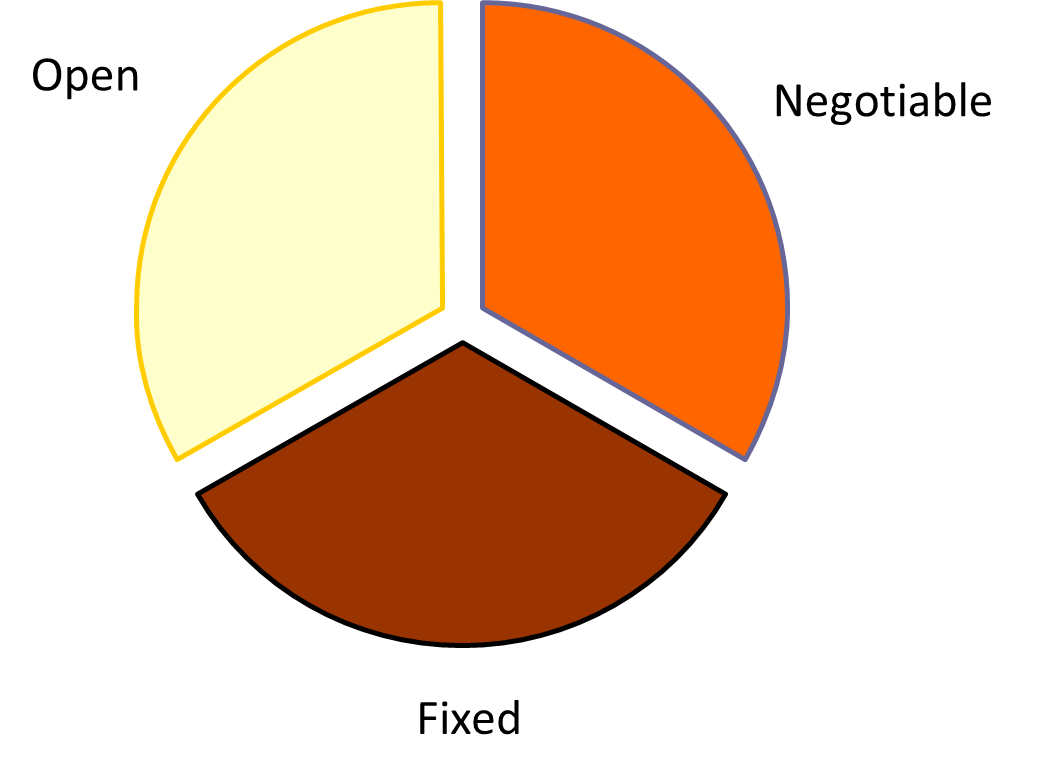
At the start, discussions within the organisation which is asking for input need to establish clarity about what’s alread fixed, what’s completely open and what there are some preferences about but where there is room for change.

Pie chart

Pie Chart: Lindsey Colbourne

Not negotiable - At the start of your engagement process it is likely that what’s decided (and thus not negotiable) may be at the level of overall objectives, and timescales.  For example, a Government department may have a policy objective and a legal deadline to meet.   A local council may know that it wants to revamp a local park, and have a potential funding source whose criteria it needs to meet.

Negotiable – You may have some existing preferences, ideas or initiatives which have been piloted and could be rolled out.  There may be some technical information which will inform the decision or be used to assess options.

Open – There will be aspects of the decision which you have no preference about and where the decisions can be in effect (even if not in law) delegated to others.

Remember that you will also have decided-negotiable-open aspects to your engagement process – the people you talk to, the points at which you engagement them, the methods and channels which are used.

The conversation you have internally with your team about what goes in each slice of the pie can often be dramatically useful: flushing out assumptions which have hitherto been hidden, and exposing disagreements within the team in the safety of your planning conversations rather than in the less forgiving gaze of stakeholders.

The pie slices shift over time

At the start of the process, it’s likely that the ‘decided’ slice is slimmer than the other two.  As the process unfolds, things usually shift from ‘open’ to ‘negotiable’ and from ‘negotiable’ to ‘decided’. Principles and assessment criteria get agreed. Ways of working are negotiated. Working groups or consultation processes are established. Exploratory conversations crystalise into options which get fleshed out and then assessed. Some options get discarded and others emerge as front-runners.

Sometimes, things can move in the other direction: when opposition is so strong that you have to think again, or when new information emerges which shows that ways forward which had seemed marginal are now much more likely to work.  In extreme circumstances, this may lead to the initiative being abandoned altogether. The recent debacle over England’s publicly-owned forests is an example of this.

Tell people what’s ‘up for grabs’

There’s no point asking people what you should do about something if you have already made up your mind.

Nice cartoon illustration here (added 5th July 2011 – thanks to Joanna Knight for the link).

By all means ask for feedback which will help you communicate your decisions more clearly. Understanding people’s concerns and aspirations means you can address them directly in your explanations about why you have made a particular decision and how to expect to implement and review it.

Do people the simple courtesy of letting them know which aspects of situation you are most keen to get their feedback and ideas about – which information will most helpful in informing the decision, the dilemmas you’d like to think through with them, the innovative ideas you’d like to test out.

That way, everyone’s time is spent where it can make the most difference.

Simples.

Thanks to…

Acknowledgements to Lindsey Colbourne and others at the late lamented Sustainable Development Commission, InterAct Networks, Sciencewise-ERC and the Environment Agency who have been developing and working with this framework over the last few years.

When uncertainty leads to conflict

Why do we find ourselves in conflict, instead of in disagreement?

One of reasons is the anxiety we feel when faced with uncertainty. Do we know the facts? Do we know the cause and effect relationships between them? How sure can we be that our actions will have the intended consequences?

I’m delighted to be able to bring you the latest words of wisdom on managing uncertainty, from Andrew Acland, facilitator and mediator extraordinaire and author of “A sudden outbreak of common sense: Managing conflict through mediation”.

Andrew says:

“Uncertainty is a feature of many of the situations in which mediators and facilitators are asked to work for several reasons. First, our work tends to be in fairly complex situations, and often uncertainty is one source of that complexity. Secondly, any situation that involves human beings involves uncertainty: we are a tricky species. Thirdly, uncertainty creates conflict – which is why we get called for in the first place.

The purpose of this note is to suggest what we can do with uncertainty when it rears its awkward head in the middle of an already difficult meeting.”

Click here to read Andrew’s full paper.

Multi-stakeholder collaboration – some headline sources

This blog entry is written for a very specific reason: I’ve just advised a group of people to look at my blog for initial sources on multi-stakeholder collaboration… but reviewing the blog I realise that it’ll be quite hard to find the things I mean, and some of them I haven’t even written about yet!

So, especially for them – and for you, dear other readers – here’s a quick brain dump of key sources and ideas which I think form a good set of starting points, mostly from my own experience.  Which means that if you have other great resources to tell people about, please do post them in the comments box.

Examples

There are some really interesting examples from the UK of the Environment Agency spending quite a lot of time and resources thoughtfully engaging in conversations with communities and other stakeholders when considering flood defences and coastal erosion risk.  For example, Shaldon and Medmerry [transparency alert - I worked on the Medmerry project] where engagement with stakeholders was carefully planned so that people could influence the decisions which the project team was making as the plans developed. Both schemes are ongoing.  See for example this report from the UK’s Sustainable Development Commission which includes Shaldon as an example, and this short case study from the Environment Agency on Shaldon.  A search using ‘environment agency’, shaldon, stakeholder and ‘liaison group’ will bring up other interesting views on the engagement approach and its success.There’s a bit more about the EA’s ground-breaking work in this area in this article on DAD/EDD.

Another place-specific collaborative approach is described in this article “Human Systems Intervention And The Natural Step” by Jenny Sardone & Magdalena Szpala, first published in AMED’s Organisations and People journal. I believe that it’s not available electronically, but I’m trying to chase down an e-version so I can link to it.

Much better known are the FSC and the MSC – now well-established multi-stakeholder organisations which tried to ‘get the whole system in the room’ to work out credible consensus-based criteria for what might be considered sustainable management of forest and marine resources.  They have had varying degrees of success over the years in getting buy-in from all the different interests (environmental, social, economic). I wrote about the MSC a few years ago, an article called plenty more fish in the sea.   Current examples include WWF-UK’s Tasting the Future, Forum for the Future’s work on tourism, and CPSL’s work on both climate and insurance. Some of these have crystalised into organisations, others are more fluid that that: fellow travellers collaborating with intention.

Theories, techniques and patterns

Fascinating to ponder on what the circumstances are which bring about authentic whole-system engagement, and what you have to do to get the right people in the room in the first place, and then to keep up the momentum. The best resource I know of at the moment on this is Peggy Holman’s Engaging Emergence.  But I’m sure there are lots of others: please help me collect them by posting your favourites in the comments box.

Favourite techniques which can help include World Cafe, Open Space Technology and Future Search. I’ve blogged about the first big Tasting the Future meeting here, which combined a number of techniques.

SDC resources on collaboration, dialogue, engagement

Since its demise, it’s really hard to find the engagement resources on the SDC’s website. So here are some direct links to some of them:

  • SDC’s response to National Framework for Greater Citizen Engagement (2008)
  • Final report on the SDC’s Supplier Obligation stakeholder and public engagement process “Household Energy from 2011″, with a description of process and findings.  There are links to other documents about this process here. [Transparency alert - I worked on the Supplier Obligation project.]
  • An independent evaluation report about the SDC’s Engagement in Tidal Power process, which brought together stakeholders and the public to think about criteria and issues in harnessing power from the tides.
  • The groundbreaking and really rather wonderful (for process geeks) guidance on designing engagement, published by the SDC but drawing on pioneering work done by InterAct Networks (Lindsey Colbourne, Lynn Wetenhall, Jeff Bishop, Richard Harris and others) and developed through practitioners at the Environment Agency among others. This work continues, for example through work Sciencewise-ERC has done with DECC.
  • Some specific gems from this guidance include ‘engagement and the policy making cycle‘ and a ‘typology of engagement’ and some definitions of different kinds of engagement. [More transparency - I work regularly with Sciencewise-ERC and InterAct Networks]

Add your wisdom

This has been a very rapid post, and most of the examples and ideas are those which I’m personally familiar with. There must be lots of others, including some great compilation resources. Please use the comments space to link to your favourites and to critique what I’ve posted here.

http://www.msc.org/

Virtual meeting – up to my ankles

In November ’09 I blogged that my toes were in the water, trying out how to integrate e-communications into workshops.

Over a year later and I’m happy paddling up to my ankles: using cut-down post-its, a document camera and telepresence.  I was delighted to work with a client which had installed video-conferencing in many locations in the UK and US.  We were able to run a half-day workshop for a small team who were spread over three different locations.

This is a stock picture from Teliris on wikimedia commons, but it gives an idea of what the room looked like. In addition to the large screens, the people in the ‘main’ room had screens in the desk where images from slide shows or the document camera were visible.

Here are some very practical lessons and tips from that experience, firstly about things you can do before the meeting begins:

  • When designing the session, keep it interactive, don’t feel that you have to make it one-way just because participants are on different continents.  Consider what might cause you to alter your design.  For example, I had expected there to be at least two people in each location, which would enable pairs / small group discussion.  But in the end one of our locations was used by just one person. So I adjusted the meeting design to include quiet thinking time, rather than pairs discussion. I asked everyone to make a note of their key points, so that everyone was ready to say something in the later round robin.
  • Make sure you check the time difference between locations, and double-check it!
  • Visit the room you’ll be facilitating from, and play with the equipment.  How do you enable participants to view slides or an electronic document?  How do you dial up the other locations?  What do you do if the connection is lost? How much delay is there when people speak?
  • If you’re lucky enough to have a ceiling-mounted document camera, can the camera pick up writing or diagrams on a flip chart sheet or on the desk?  How big does the writing need to be? Where are the edges of the camera’s vision, and do these match the edges displayed to participants in other locations? Mark the edges with masking tape.
  • Make friends with the IT / facilities team.  What works well in their experience, and what trouble-shooting tips can they share.  How do you get hold of them during the meeting?

In the meeting

Having worked out how the document camera worked, and tested different sizes of post-it and handwriting, I was able to use small square post-its to record individual contributions and move them around until we had collaboratively created a timeline of the organisation’s journey to this point.

Later in the session, I recorded contributions about people’s vision of the future in a mind-map which was also broadcast live to the people in other location, via the document camera.  Unfortunately one of the locations lost the feed, so we ended up with some people not being able to see what the rest of the meeting could see: an imbalance which we were unable to correct before the meeting ended.

For my own use, I made a little map of who was sitting where, and used it to keep track of who’d spoken. This enabled me to invite contributions from time to time.

This was a half-day meeting, so I built in a comfort break which everybody really needed. Keeping focussed and engaged in virtual meetings are harder work than face-to-face, I think.

Improvements?

In future, I’d like to work out a practical way of integrating a running record into a meeting like this.  A simple word document shared live through google doc or a similar system might work.  You would need to check that everyone could access it – firewalls might be a problem.  Alternatively, a bespoke webmeeting package with a whiteboard could be used. I’m getting experience of both Huddle and Central Desktop in different client work at the moment.

What’s down the back of the sofa?

It’s the time of year for clearing out the cupboards and taking all the cushions off the sofa to sweep out the composting satsuma peel.  So I’ve been through my email inbox dealing with things.  And there – among the discarded invitations to really interesting meetings and unanswered requests for advice on things I just didn’t know enough about to reply rapidly – was a jewel, waiting to be rediscovered.

I get Michael Neill’s weekly coaching newsletter, ever since I went on a two-day coaching magic course which he ran in conjunction with Kaizen Training.  Each Monday morning week there’s an anecdote or exercise and they help me understand better how to coach, consult to clients or facilitate groups.  Of course there are also notifications of the courses he’s running or books you can buy, but it’s easy to ignore that stuff if you’re not in the market for it.  (From time to time I get a bit exasperated with the recurring theme of money, earnings, finances and feeling rich.  That’s not why I’m interested in coaching. I ignore those bits too.)

A Conceptual Jewel

The jewel was one of Michael’s conceptual frameworks.  I’d kept it in my inbox so that I’d remember to blog about it at some point. That point is now.

It’s the Four Quadrants of Creation, and it’s a way of understanding what might be getting in the way of you achieving or creating something.

I think this is a great framework to have in a coaching toolkit, and I wonder if it can also be used with a team – for example a transition group, or a sustainability team within a larger organisation, or a consultant team reflecting on a particular ‘stuckness’ with a client?

Michael says:

Think of something you have thus far failed to achieve or create…

Now answer this question:

Is it because you couldn’t, you didn’t really want to, or both?

He goes on to talk about the twin importance of commitment and competence.

“Commitment is your “want to” – the amount of desire and willingness you bring to your project or creation. Competence is your “how to” – the amount of skill and capability you are currently able to harness.”

Sorry about the poor image quality – it’s better in the original.

You can probably see straight away how this can be used in a coaching situation: the coachee can consider where their espoused goal is in this matrix, and whether it’s insufficient competence or weak commitment which is holding them back.

What’s holding you back?

One of my coaching clients has been using a metaphor of baking a cake, for achieving a particular goal.  At the moment, something is getting in the way of moving forward, and it is as if the cake batter is being stirred endlessly.  It could be that more stirring is what’s needed – when the mix is ready for the oven, it will be obvious.  Or perhaps there is a reluctance to let go of the comfortable and known act of stirring, and take the irreversible step of putting the potential cake into the test of the fiery furnace.

Only the client can know this, but the framework can help them to discover ‘what is’ and work with that.

The framework with a team

Could this framework be used to help a team reflect on its progress towards a goal?  There would need to be a high degree of trust in the group for it to be used successfully: who wants to tell a colleague about their own lack of competence, or question another person’s commitment to a team goal?  A prior agreement not to use self-disclosed low levels of competence or commitment against each other later would be needed.  Self-disclosure would need to go before reflection on the team as a whole.

In some situations, it would be very helpful to have a framework for understanding what competence is needed for the task.  For example, this framework is about sustainability leadership.   A structure like a spectrum, with attitudes to the goal marked on it, may also help to give permission to people to be honest about their level of commitment. The horizontal dimension from the ‘who can help me‘ matrix is a possible tool to use for this, if some additional options are added in between the extremes.

Dotting along the scale would form a whole-group picture of where people stand, which can then be used to focus discussion on the team’s commitment and what would increase it (or what alternative goal would elicit high commitment).

The matrix could also be used as part of prioritising a team’s work – something which will surely be more fraught as cuts make themselves felt in the public sector here in the UK.

Find out what you are really committed to

Some goals enthuse and inspire us, generating remarkable levels of passion and energy and bringing out the best in us.  Others feel more like burdens or accusations, staring at us sulkily from the teetering pile of unread journals or the magic inbox which can apparently hold an infinite number of low priority emails.

Peggy Holman, in Engaging Emergence (fantastic book which I keep recommending to people and will blog about properly one day), talks about “taking responsibility for what you love as an act of service“.  If you move towards the things which you really care about, you are providing your best gift to the overall endeavour.  You don’t have to do it all, and you don’t have to do the things you think you should do – just the things you love to do.  This strategic selfishness is echoed in Michael Neill’s thoughts about commitment:

“…check to see if this really is your project or if it’s someone else’s dream placed in your hands. If you decide to fully own it, notice any thoughts about why you can’t or shouldn’t really allow yourself to want this for yourself. Authentic desire doesn’t need to be created – simply uncovered, one limiting belief at a time, and given space to breathe and to grow.”

Don’t thingify the elephants

I’ve just got back from a great workshop organised by ODiN and run by Delta7.  We explored the use of pictures, in particular those which visualise ‘the elephant under the table’.

It’s always great to see some old friends and meet new people.  Also good to have the time to reflect on stucknesses and opportunities in my own work which might helps us in this collective endeavour of forging a sustainable future.

So Julian’s picture about climate change at first felt like a comfortable one for me to look at and discuss.  It was familiar territory, summarised what I consider to be an important part of my own work and practice, and gave me a platform to build on.

Too comfortable?

Someone raised the question of the shadow side of naming ‘elephants under the table’.  (I can’t attribute this insight, as ODiN meetings are Chatham House.)  He said that by ‘thingifying’ the metaphor of the elephants under the table, we can shrug off our personal responsibility for them.  I am not forgetful: I have ‘senior moments’ which exist independently of me.  I am not failing to pull my weight around climate change: society is in the grip of denial.

So here’s my challenge to myself: to reflect on the sustainable development elephants, and give people courage to name them, without ‘thingifying’ them and thus distancing myself from them.

Breaking the Ice

Here are three great ice breakers for meetings, as described in a recent column in the environmentalist.  They are:

  • what we have in common;
  • human bingo;
  • getting to know you.

NB the photo used to illustrate the article is not a meeting set-up I would recommend. And what’s with all those tissues…?

Use, adapt, enjoy, tell me how it goes, and warm things up a bit.

Penny’s blog

Portrait of Penny

Thoughts, updates, links, and essays on creating change for sustainable development.